How I took a career break
What better way to reflect upon one's recent burnout recovery, than to speak about it at Code Camp Wellington 2026?
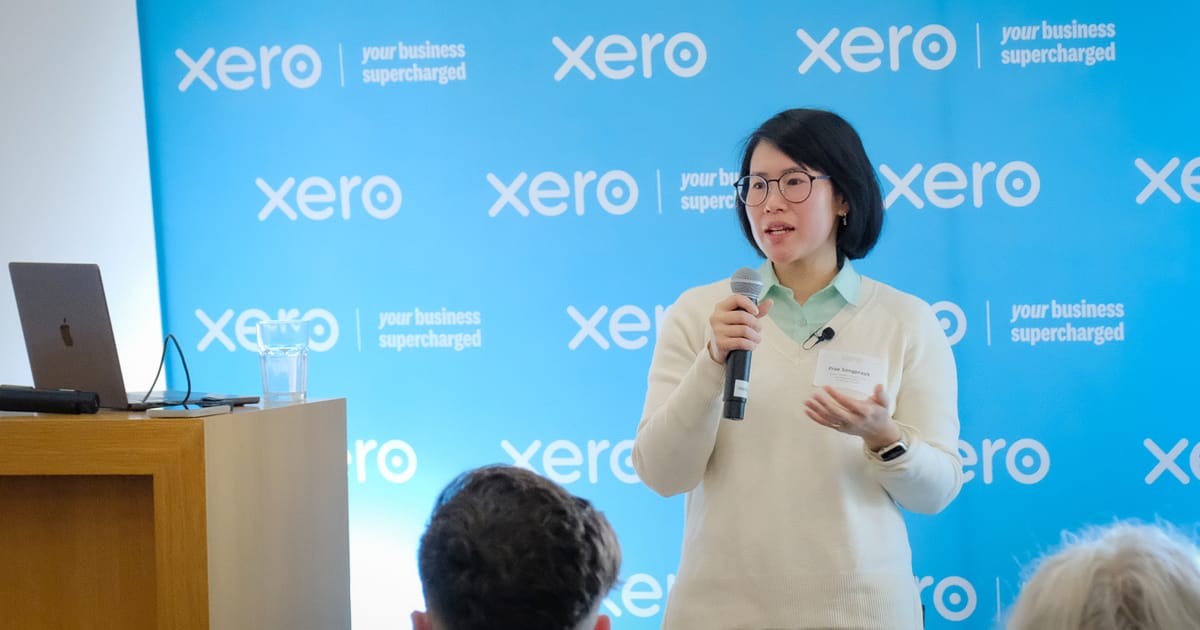
Edited transcript
Welcome to yet another burnout talk!
So the fact that you're sitting here is a signal... and I wonder what's going on in your heads, why you chose this talk. I mean unless you're my friend, then you know that's a different story.
The fact that this talk was selected, when I submitted two others, is probably showing/telling of the state of industry, or the organisers, or how the organisers perceive the audience's state to be. So hopefully this will be a kind of a healing journey for some of you, or to be horrified with what's coming up. Whatever works for you there.
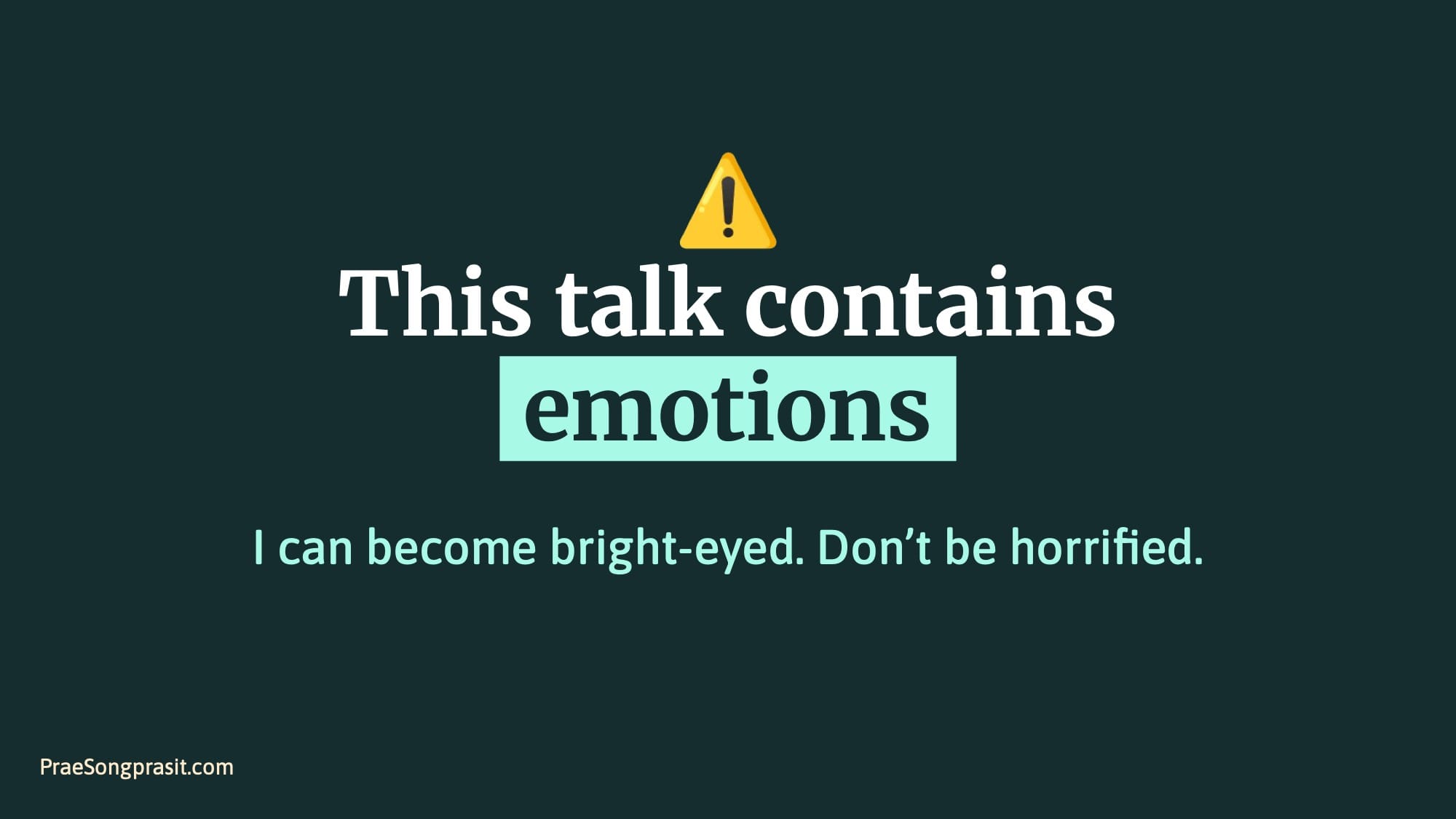
Now this talk does contain this thing called emotions. Rather uncomfortable to be doing it on a stage on a Saturday morning, in one of the places that gave me two of my burnouts... but you know... whatever right?
So if you see teary eyes, that's okay. I'm actually much better than when I first started writing this talk, or when I had my burnout. So, don't worry. Don't panic. Don't feel upset. Don't try to get up. I'll get over it. It's fine. It's just a residue feeling. I'm not feeling upset right now.
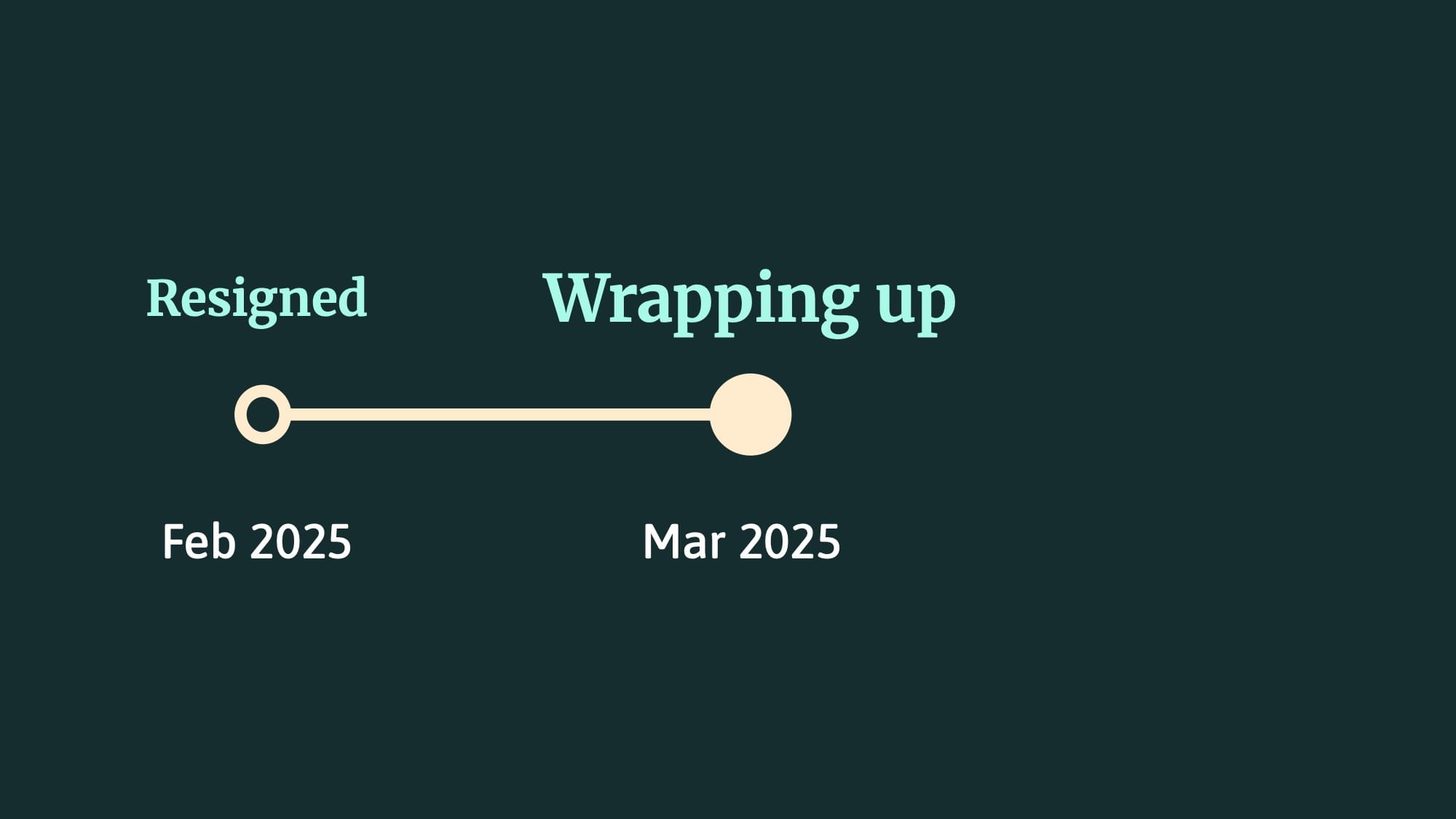
So this time last year, I had already submitted my resignation. In March 2025, I was in the middle of wrapping up my things, preparing to leave a company that I invested almost seven years of my life in. I invested in the people, the product, the process... you know all that jazz, and the community around it.
I was burnt out.
If you look at it positively, by this time last year, I have stopped crying in the middle of night. I was looking forward to things that I could be doing with my life over the upcoming 8 to 12 months career break. It was something I was looking forward to. At the time, I was like, oh, I could:
- go back to painting
- do more Japanese archery that I've loved and been doing for 10 years
- blog some more... I was blogging but I was doing blogs internally in the company so the content cannot be taken out so I could start properly blogging outside the company.
- explore one of the 52 ideas (actually it was 54 by the time I left) of side projects and things that I was interested in doing.
I could do all of those things, and they will keep me entertained.
I would not run out of things to do over my career break that was coming up. So, at this point, I was kind of, you know, looking forward to it. Not happy, but just looking forward to improving my mental state.
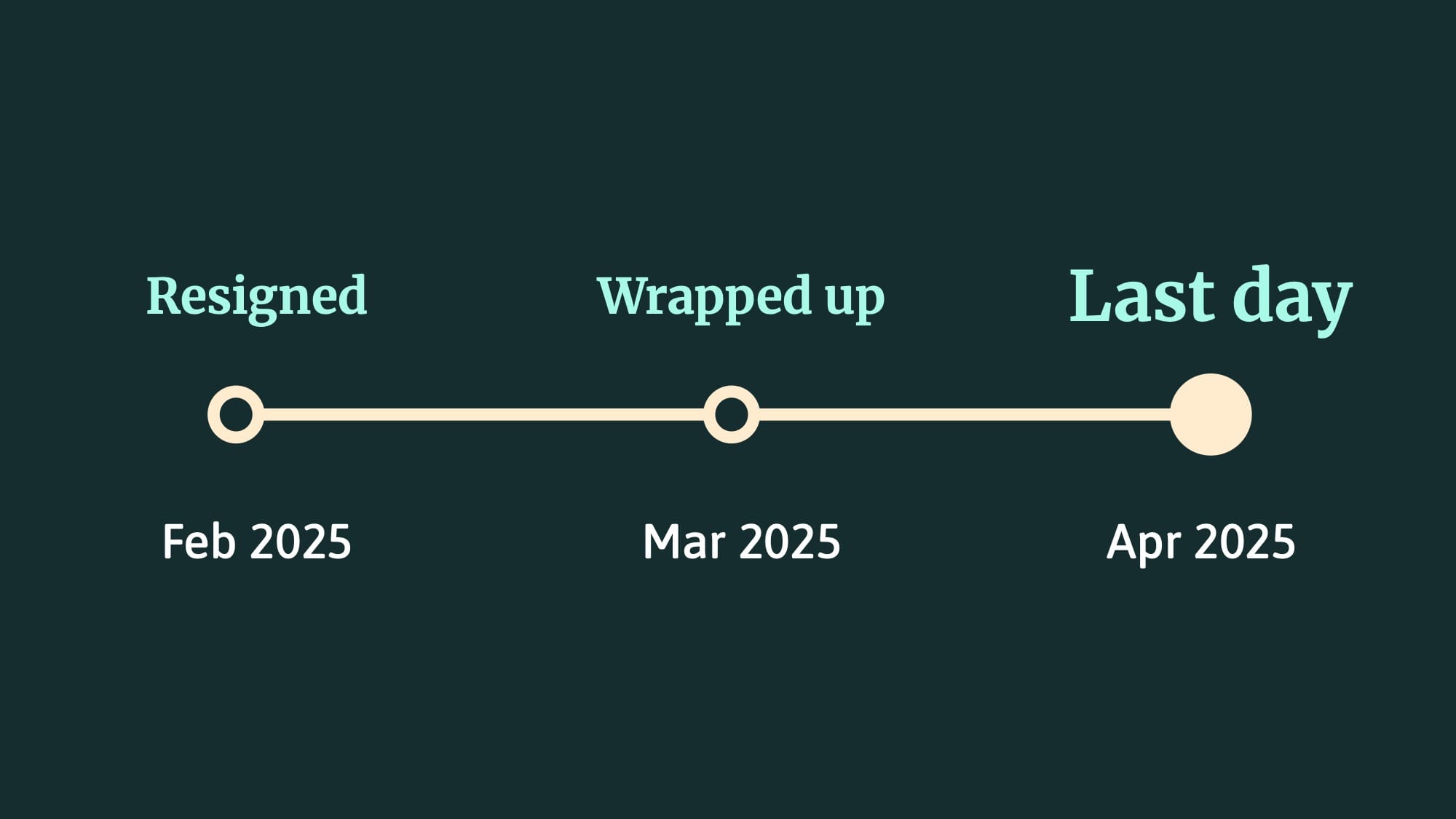
Now, fast forward to my last day in April. It was numbing.
I felt almost nothing, as I was heading from the wrapping up phase in March, heading towards the last day in April.
Every day I would turn up. I would continue to support my team and the people who have supported me. I continued mentoring others and being mentored. Did all the works that I was supposed to do, make sure the handovers wrapped up nicely, documentation's done... I even committed a whole codebase linting that we've been wanting to do for years. It was great.
When the countdown was over, I intentionally chose a day in which hardly anyone will be the office. I wanted to leave without fuss and leave in peace.
It kind of helped that my teammates were all remote. The team that I was with were all in Australia, US, and other parts of New Zealand. So they were not going to turn up at the office on my last day. And all the people who I'm friends with, who work regularly in the office in different teams, don't come in on that day.
It was intentional. So I could just basically wrapped up my laptop and go.
I wrote my last spicy internal blog post. I dropped it off and then I head over to IT. Actually was finishing writing my blog post with IT and dropped the laptop off. Handed my lanyard over at that front desk over there. I've now found there's a little hole for you to slot your lanyard in, which must be saying something. I've just discovered it afterwards.
And when I left the building, I was one MacBook lighter... and a whole lot of emotion kind of just... not went away, but was less prominent. I wasn't happy. I was just feeling nothing. But the whole point of this last day... the whole point of this upcoming career break, was so that I could feel something again. I could feel happy. I do something I love and come back, or not come back, switch career with more energy than I was before.
But to understand the chain of decisions that lead up to this long career break... or not long, some people took three four years career break, but for me this eight months was quite a long time. Um, to understand why I concluded I need to stop working in order to recover. You need to look at my burnout history.
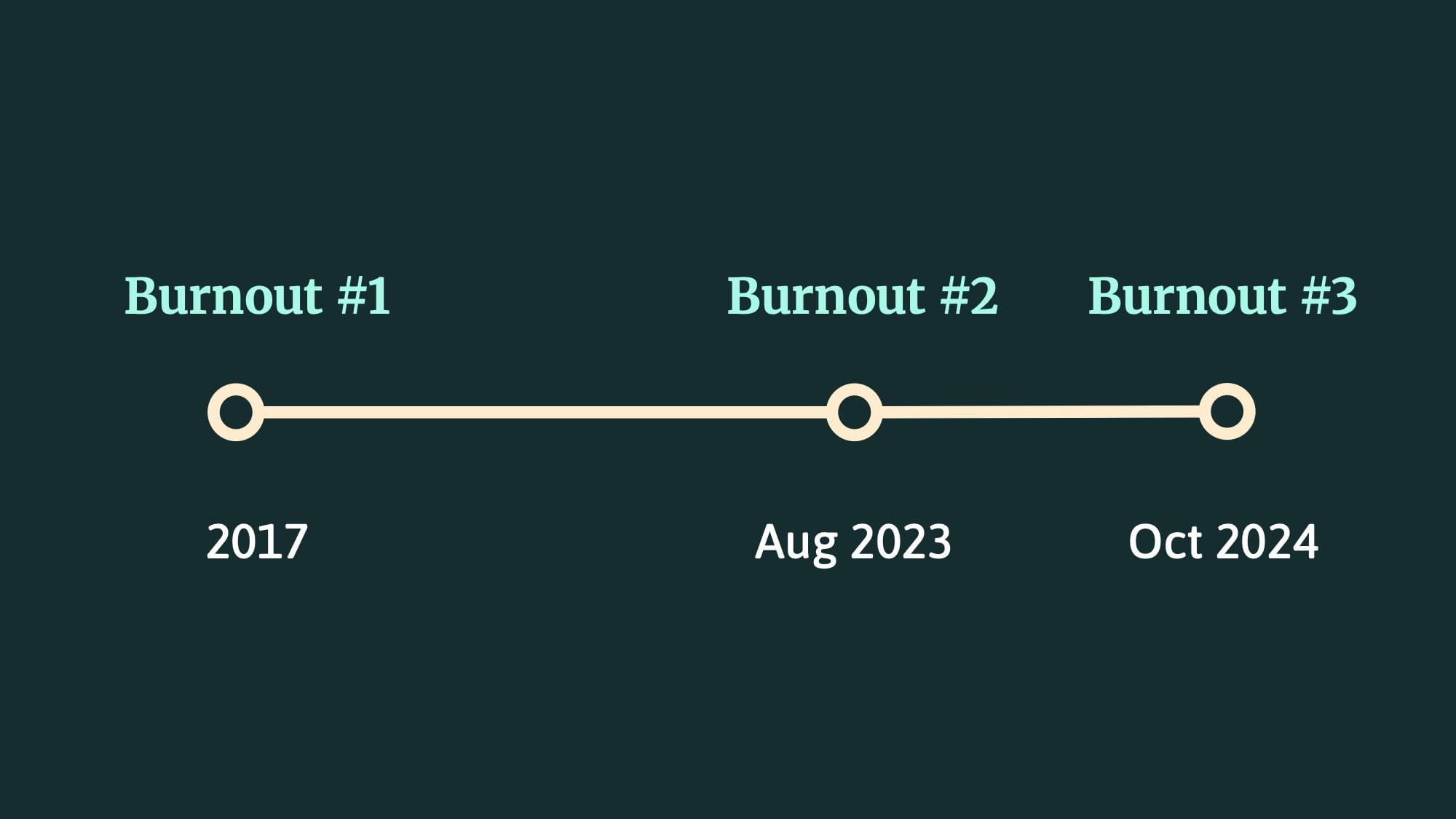
I've had three full-blown burnouts. I had some close calls, but the full on burnouts happened three times. All of them over my last decade in tech.
So I've been in tech for 10 years.
I've always been a UI/UX accessibility focused person. So it is my job to care about user, accessibility, but also the experience of the people working around me: how they're interacting with the tools, how they're interacting with concepts, do they understand enough to then elevate their own work or the quality... Even the way I pitched that sounded passionate right?
I also do a lot of community work. I hosted events, I try to mentor others, I try to help raise voices... you know, doing all sorts of things that would generally help make the people's experience working in this industry around me better.
Um, the first burnout was actually in 2017.
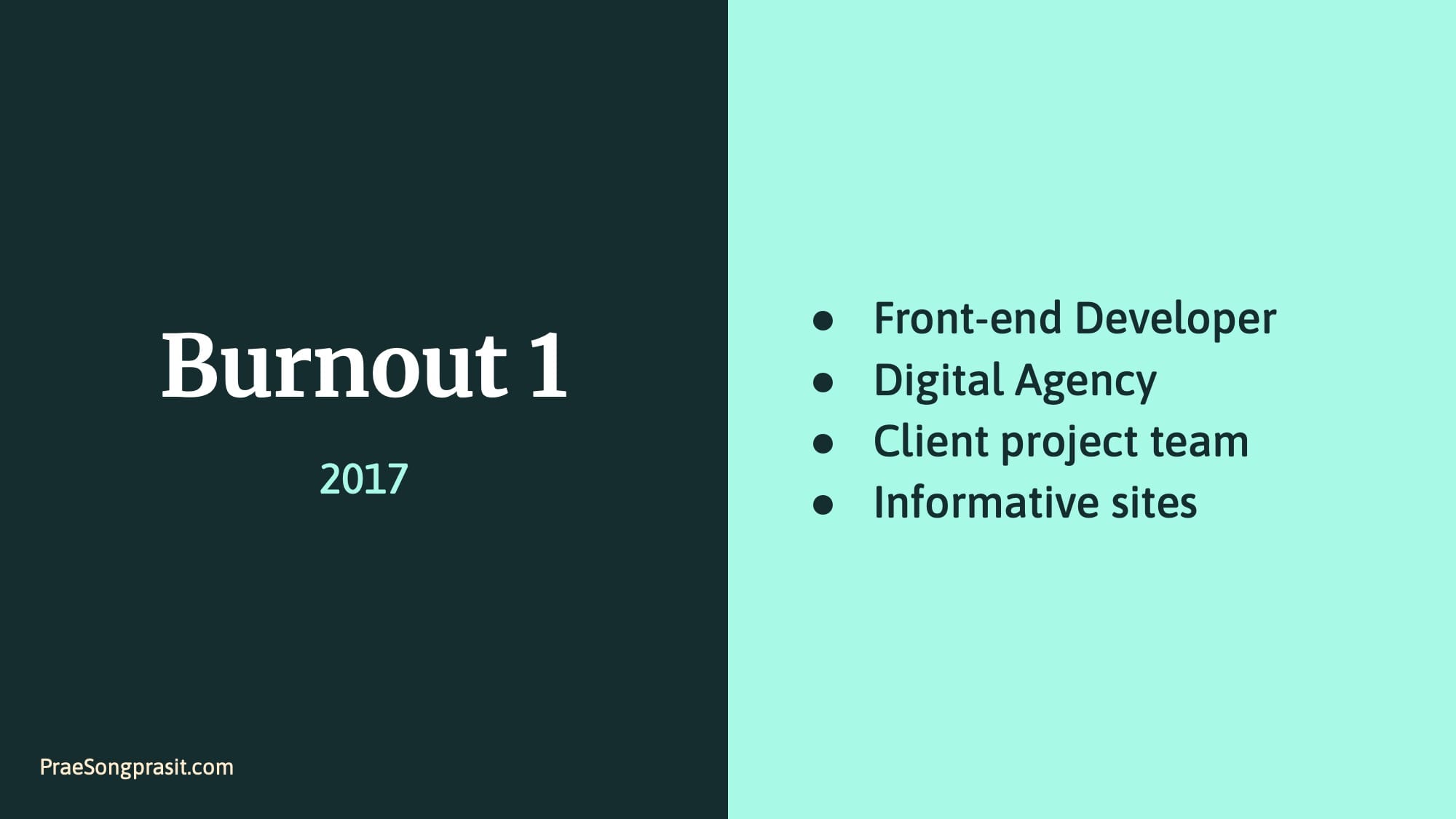
The first burnout was in 2017. At the time I was a front-end developer — humble junior becoming intermediate. I was working at a digital agency, working with big clients on really interesting informative sites. But because I'd spent four-plus years at that company, I'd grown from junior to intermediate, tethering towards senior. Because it was a small place, there was only so much room to grow — there was always going to be a senior or decision-maker above me, and those roles were filled by people who'd also grown into leadership there.
What was getting to me wasn't the role level — it was that I was directly interacting with clients, seeing all these problems, hearing from their point of view what was wrong with our service or what we were delivering. I'd come back and go: "The client said this. Here's all these things I want to help with. I know I have the skills. Can I please be allowed to help?" And of course, because of the nature of a client-charge-per-hour relationship, I just didn't have the authority — I wasn't senior enough to make decisions on those projects, nor the autonomy, because we were locked into whatever the vendor-client relationship asked us to be. I could only help as much as my 40 hours that week allowed. I couldn't help beyond the agreed scope.
I didn't know about burnout at the time, of course. Then one day I was walking up the office stairs and I started crying. That was surprising, because when there's a problem I'd normally analyse it, find ways around it, solve it and move on. I don't really dwell. So the fact that I started crying walking up the stairs — that was a big red flag. Everyone was like, "Oh my god, Price is crying, what's happening?" The seniors were running around like headless chickens with no idea why.
I had to take a break. That was the first time I went through counselling — we had an EAP at the company, so if you have one, make use of it. As we were digging through the causes, I realised the situation clearly: I had no autonomy. I was passionate about this thing but being blocked from doing what I felt was important, what my clients recognised was important.
That helped me put words to the feelings and work out the next step. If my problem was that I needed more authority and autonomy in my work, could this current workplace provide that? No. An agency is not really going to give you that. So my solution was to leave — move to a product company in a senior specialist role, where I'd get more authority over the things I'm good at, and the role level to contribute to how my work runs.
Did that help? Yes, actually. It was great for the first two or three years.
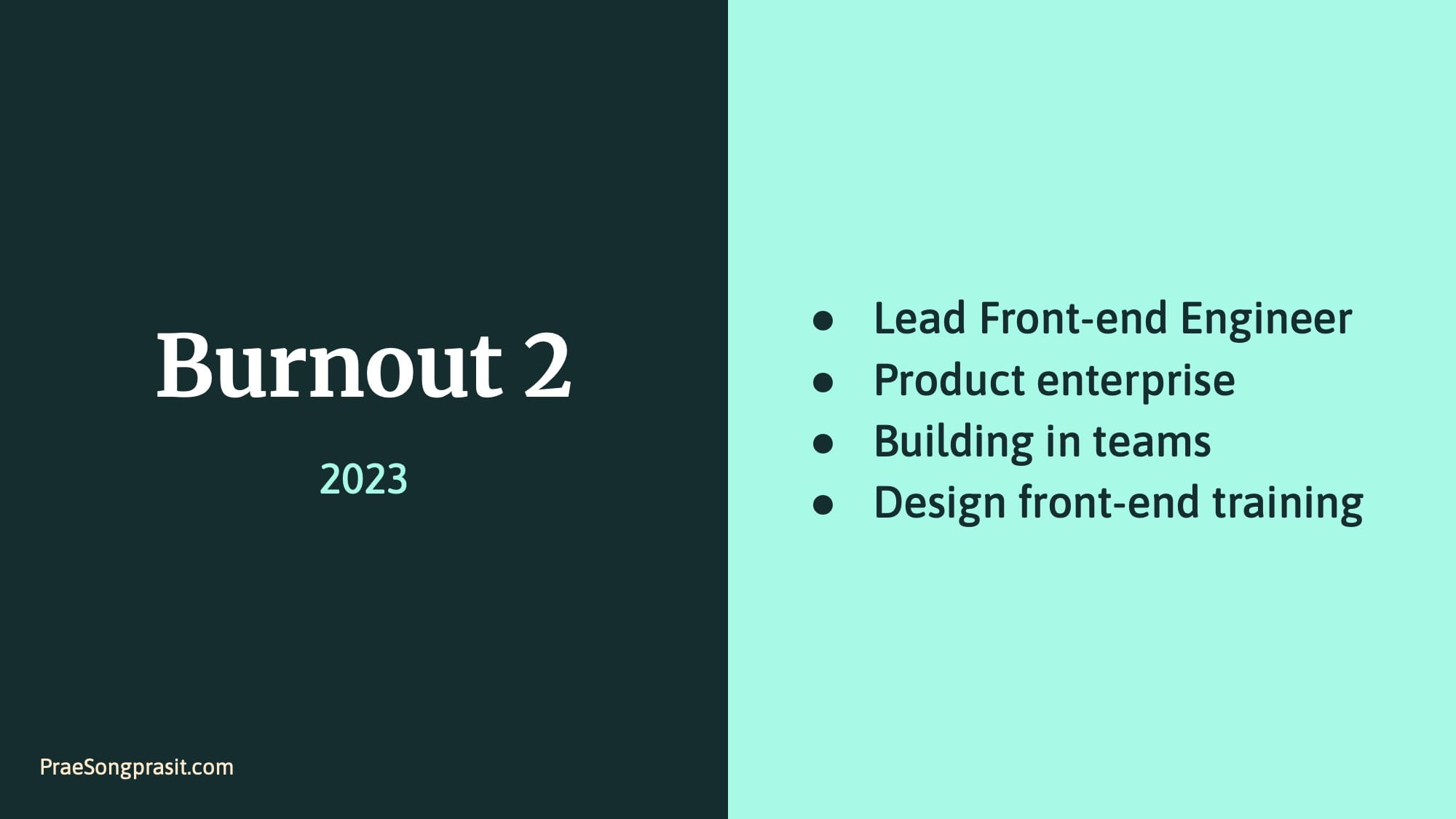
Then came burnout number two — thankfully with that huge gap from 2017 to 2023. At the time I was working at a product enterprise company as a lead engineer in a very high-performing team, in an area I was deeply invested in. It was one of the best-known features of the company, the team was great, everything was lovely. But if you recall, 2022 and 2023 was when the tech layoffs trend hit — first in America, then trickling down to New Zealand. There was a lot of organisational grief. Lots of people were upset, people who left, people who were forced to leave.
Even though it didn't impact me directly, it impacted the company's morale. With fewer people, you need to reorganise — what do we prioritise now? What do we do with the people who remain? My role was to help build products with the team, upskill a little bit, but my main goal as lead engineer was to upskill other engineers in how to implement the UI and front-end in a more accessible, more friendly way. The design system team had spent ages refining those components, and I was there to make sure engineers used them properly.
But as soon as the team's purpose shifted to something that wasn't user interaction or user design — our designer was taken away, that was the first sign — the upcoming projects became all very backend, data-heavy. I don't disagree with that direction, actually: doing that front-end project made me realise that if our backend were easier to access, our front-end would have been so much faster. But it meant no one had appetite for front-end learning, front-end training, accessibility, or the software craft. Nobody was working on the UI. My purpose in the team was almost redundant.
Then I was put in a team that already had a line of succession for the senior role, and because the whole area got restructured, I was taking up headcount in a team where I'd be a junior — learning backend stuff with a senior title while operating way below my expertise.
With the whole morale being low, the way they wanted to use my skills, how I could contribute — all that factored into yet another burnout. This one was bad enough that I realised: I need to just stop for a bit. This was fresh off the layoff rounds — maybe three or four months out. Planning was still happening.
I just wanted things to settle down enough that I could come back and go: right, now that the grief is partway through, there's rebuilding — where can I contribute my skills? So I requested three months off. One month just isn't enough; everyone takes one month leave and then comes straight back into it. I needed at least a month and a half to two or three months just to kind of recover.
Did the three months and the new role help? Yes, it did. But I realised I was coming back to a very similar situation — which leads me to burnout number three.
You can see how the timeline between the first and second burnout is very different from the last two. The constant restructures continued — the same low morale, people still finding their way around new systems.
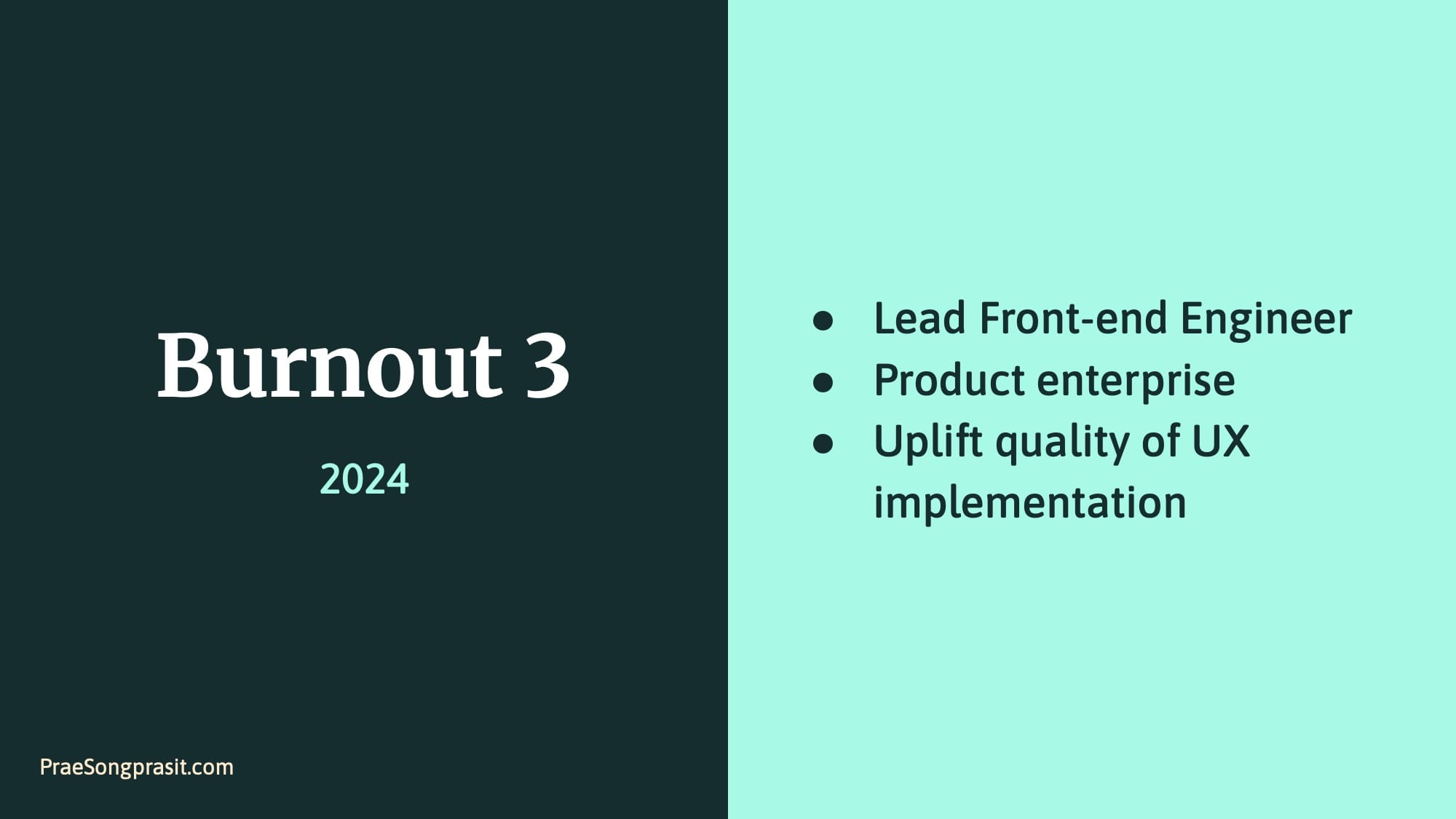
In this new team I was lead engineer, focusing on uplifting the overall quality of the company's UX implementation. The thing I'd wanted to do in a particular product area that no longer had appetite for it — I now got to do at the company level. A wider scope, a team of specialists, teammates who were super motivated. All great.
But then the organisation restructured again. What led to this particular burnout was weird — I was already feeling better when I came back, and then I started seeing trends. How people were talking about things. How our work got assigned — from quality-focused work, increasingly becoming paperwork and red tape. Our whole team's skills were slowly being devalued.
If I ask myself: is making this slide deck for a certain leader's meeting the thing I care about — uplifting the quality of UX across the organisation? No, it's not. I'm just pushing paperwork to a deadline and not seeing any value in it. And then of course, I was promised a lot of autonomy as lead engineer in a team of specialists who educate. But soon after I came back, things shifted, and we started getting handed work: "We need a proposal on this by Friday — well, actually it was yesterday, but I'm giving you another two days." With this hamster wheel of paperwork and mismatched value, it just eroded the team's morale.
The same symptoms as the second burnout started appearing — constant tiredness, crying in bed, tearing up randomly.
But this time I was even more negative in conversations with people outside my team. That's telling something, because if you've interacted with me in any capacity, you know I try to be optimistically realistic about how we could do things. If I'm constantly negative, something is wrong.
Looking at burnouts one, two, and three, patterns started to emerge.
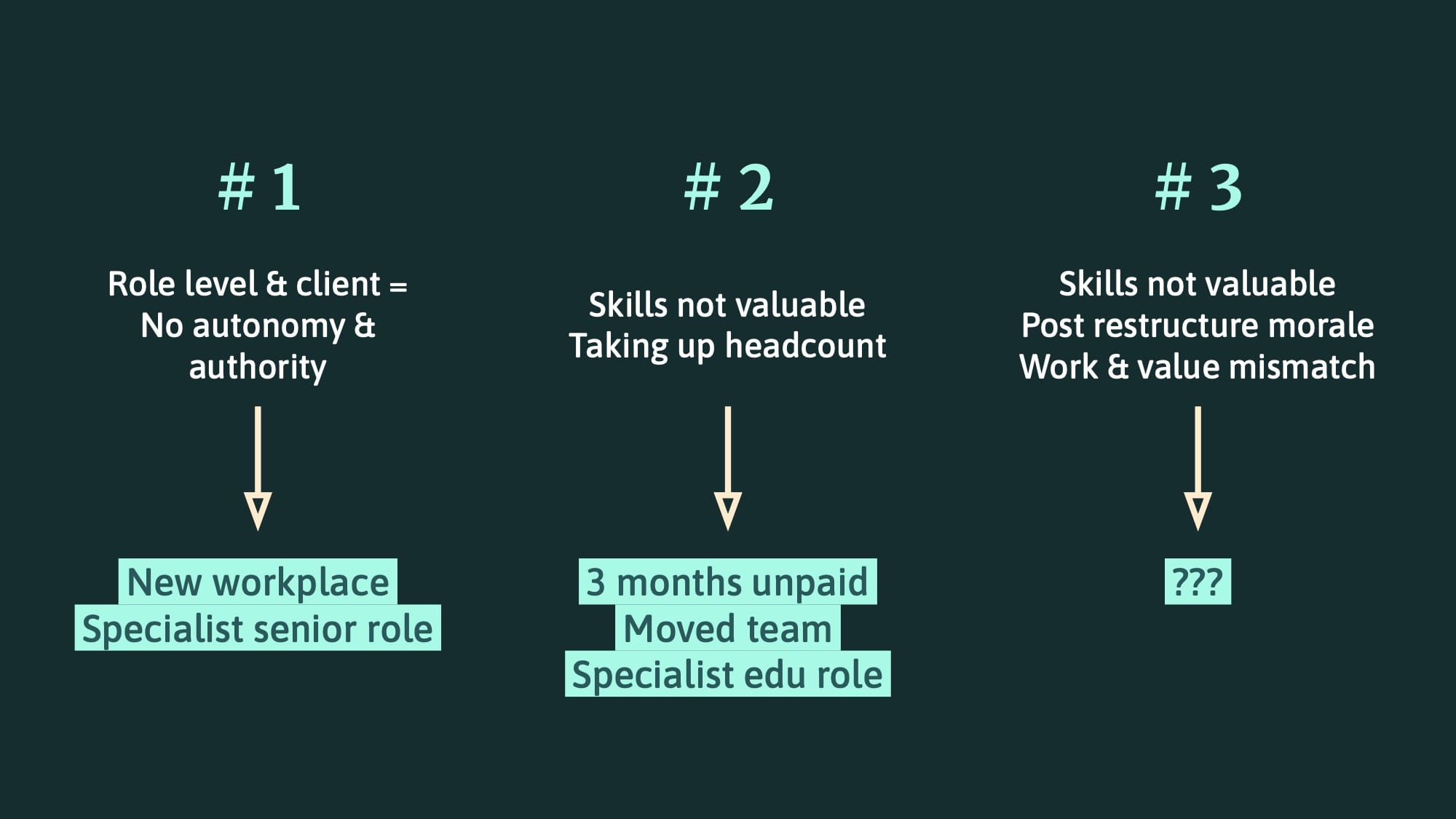
Burnout one: no autonomy at the client level, no authority. Solution: a specialist role at a product company. Tick.
Burnout two: skills not valuable, taking up headcount, bad team dynamics. Solution: take three months, move into a new team with a specialised education role that meets my personal values. Tick.
Burnout three: skills not valuable, post-restructure morale, work value mismatch. What would resolve this? Leaving — but in what terms, for how long, and what comes next?
In order to resolve this, I needed to take a really close look at myself. After a long examination and talking to a lot of people I'm friends with, I realised: I care.
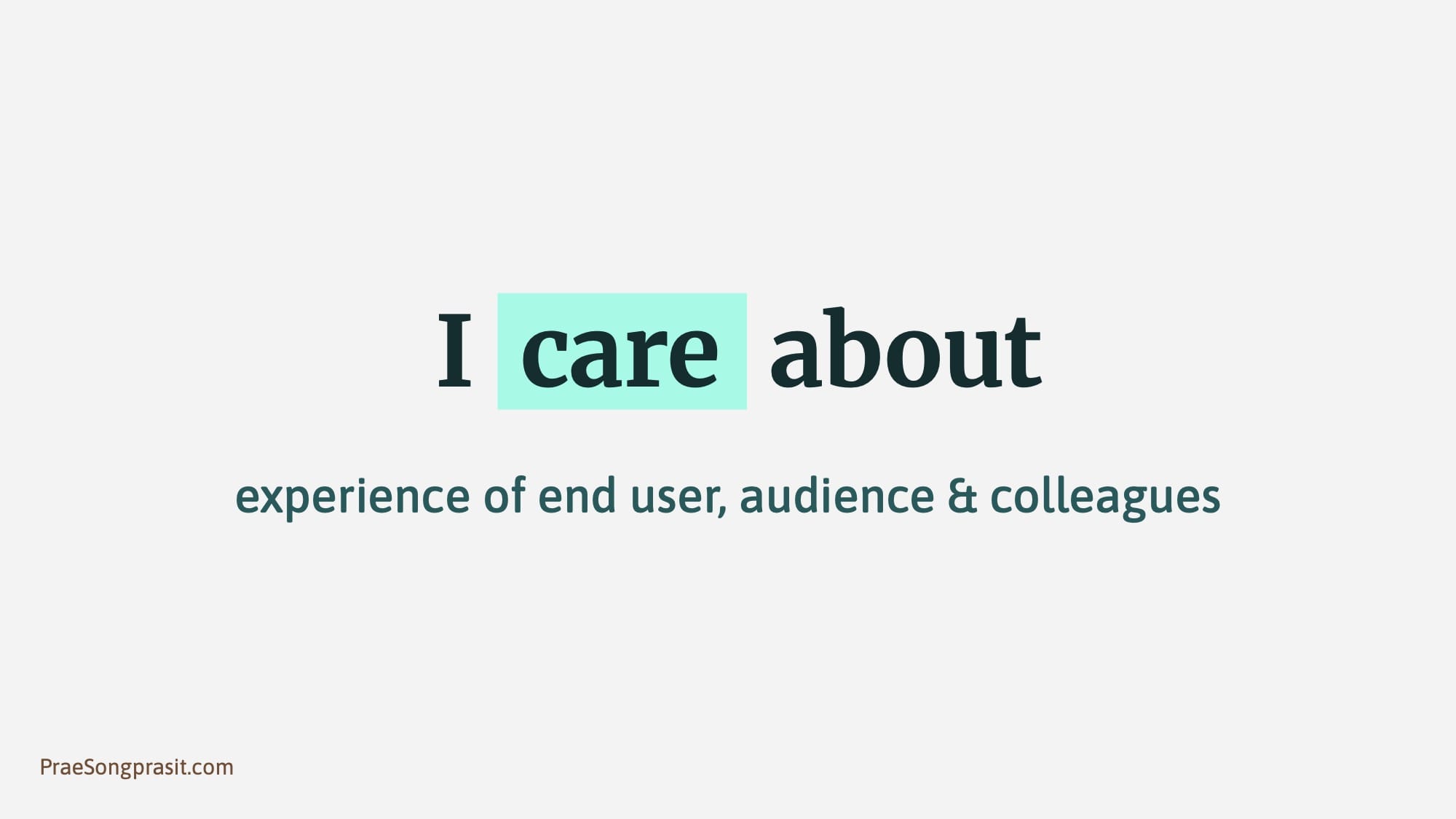
Not just care for no reason — I care about very specific things. I care about the experience of the end people reading my work: documentation, user experience, the tools I build. I care about the audience of my talks — what takeaways they're going to have. I care about my colleagues — what is the experience of interacting with me? How are we operating as a team? At what morale level, at what efficiency?
And so when I burn out, I naturally burn out when I don't see the value in the things I'm building or working on. When I don't see how it even helps. When I don't have a say in how I do certain work. I don't want freedom for anything — I'm realistic, right? But what I want is: hey, you hired me as a specialist, I know enough about my work to make certain decisions. Don't give me a list of documents to just tick boxes — AI could do that.
I also learnt that I get personal satisfaction from meeting my own personal standards.
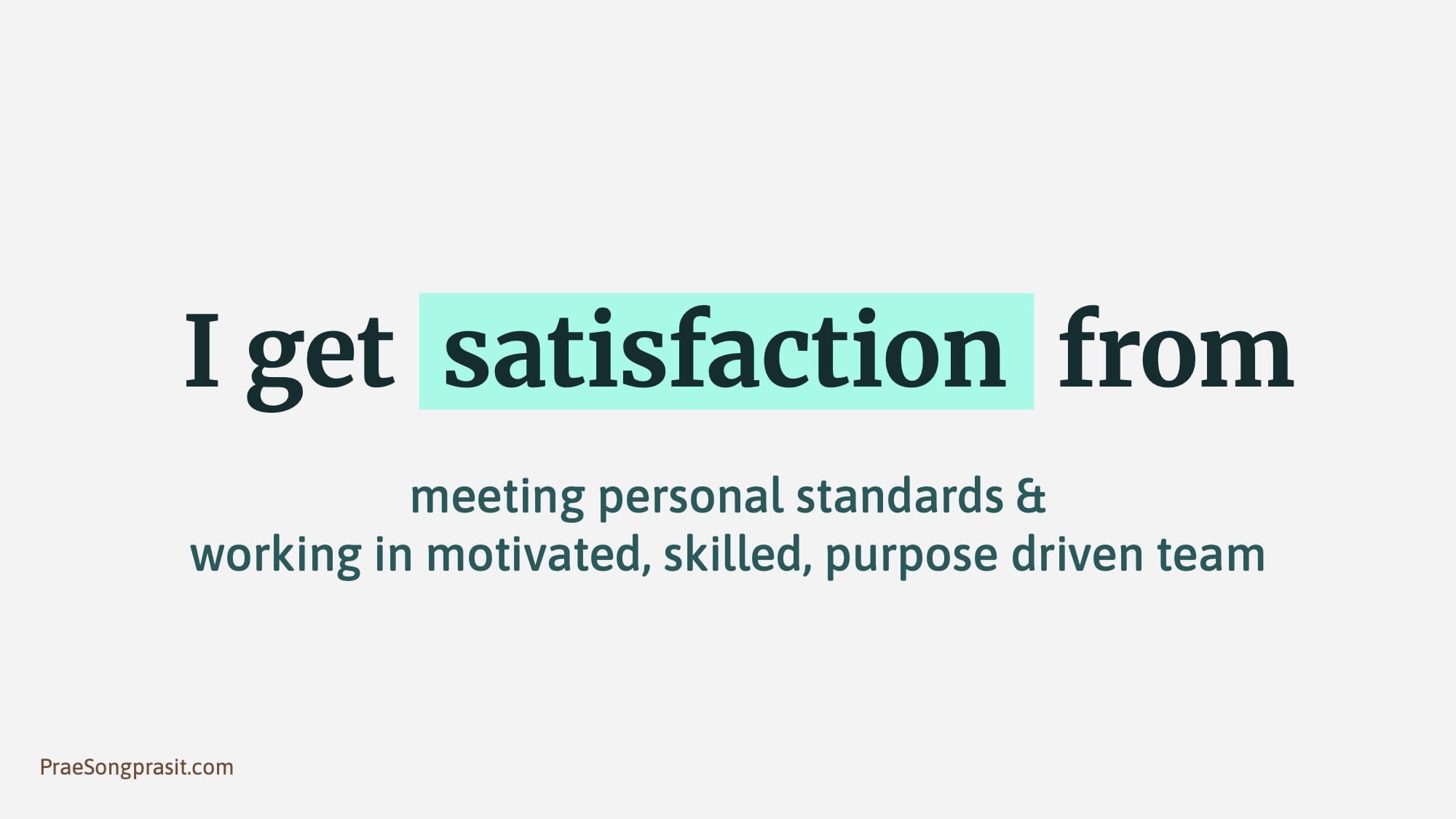
Now, that sounds like it resonates with a lot of people. Some might say it's perfectionism. No — I can leave that kitchen half clean, that's fine. There are certain things I have personal standards about, and I don't care what your standard is, but if it's my work, I want to make sure it's at least a little bit cleaned up. At least the slide is readable. At least the contrast is clear. At least it's bullet points, not a wall of paragraphs. There are certain things I feel satisfaction from that I don't even need praise for — I just know I've done it to the level I'll be happy with.
I also like working in motivated, skilled, purpose-driven teams or groups. Hence why when everyone is demoralised or not allowed to do what they're good at — that's a recipe for another burnout. Hence burnouts one, two, and three.
It's also worth noting: it's not just purpose-driven for purpose's sake. I also get burnt out when I work with unrealistic people. We've all met those humans — they're lovely, they're optimistic, they're bubbly as hell, they're like "we could change the world." And I'm like, no, you can't. Not within 40 hours at this level of pay.
Now that I knew what I cared about and what gave me satisfaction — basically, having control over the quality of my work and how I work — let's look at how I could resolve this.
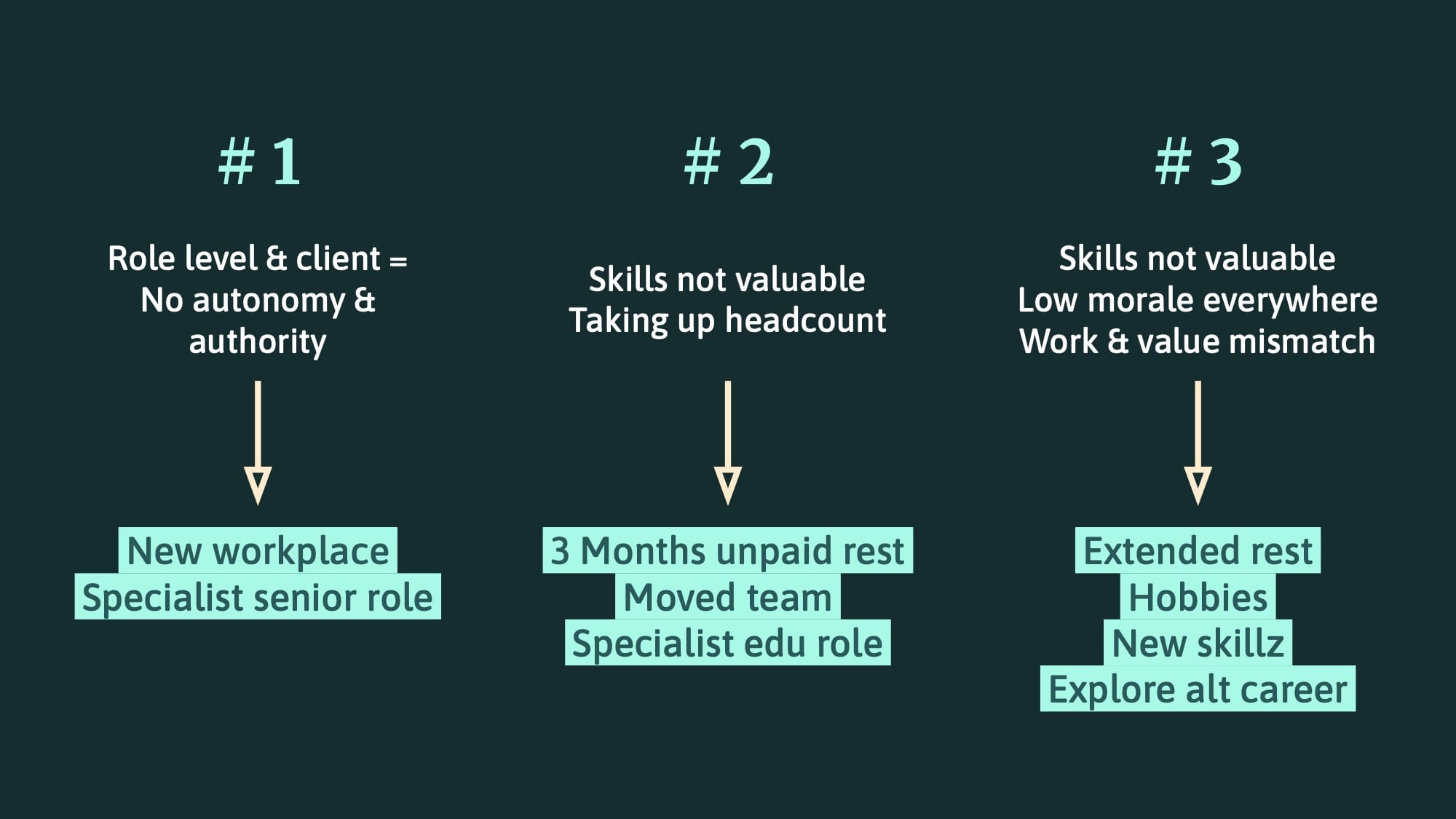
First of all, I was freaking tired. I was just done. I needed to take a break, to be away.
And I'd learnt from the second burnout that three months was good, but I still came back only about 70–80% recovered. To get to 95%, I needed a much longer timescale. But also, after all this, I was genuinely sick of the industry. Let's be real: no one cares about front-end in New Zealand. No one. The fact that I specialise in this thing that no one cares about was already putting me on the back foot. I needed to expand my skill set. The reason I hadn't been able to do that previously is that I'd gotten so good and well-known at the things I'm good at that I was constantly pinged about those things — which I'm happy to do, but it let me run away from the things that always scared me. The deep dark bit of the RDS database. The things I know the keywords and concepts for, but just haven't done in practice.
When you don't know something, you naturally have fear, you skirt around it, you find small excuses to avoid it. Even though you're interested and want to learn it, you're like: "Oh, but if I had to deliver this tomorrow, I'm a bit reluctant. Can someone else do this while I go read your pull request later?" That's the tendency I've been operating with as a learner.
So I needed a break. But I also needed to expand my skill set. And while breaking, of course, I wanted to do my hobbies, recover, get better. At this point I was numb. How do I get that spark of joy back? If I can't do it at a workplace because no one cares about front-end, then I need to find something else to care about. I have many hobbies — I sew, I walk, I paint, I do Japanese archery. There are so many things I do that I just stop doing when I'm burnt out or depressed. Let's get those back into my life. And, if possible, explore alternative careers — by this point I'd already co-founded a company called Tech Rally, so I knew I could do all parts of that kind of work, including event organising. I'd left it in the end for various reasons, but I knew I wanted to find other types of work to be involved in.
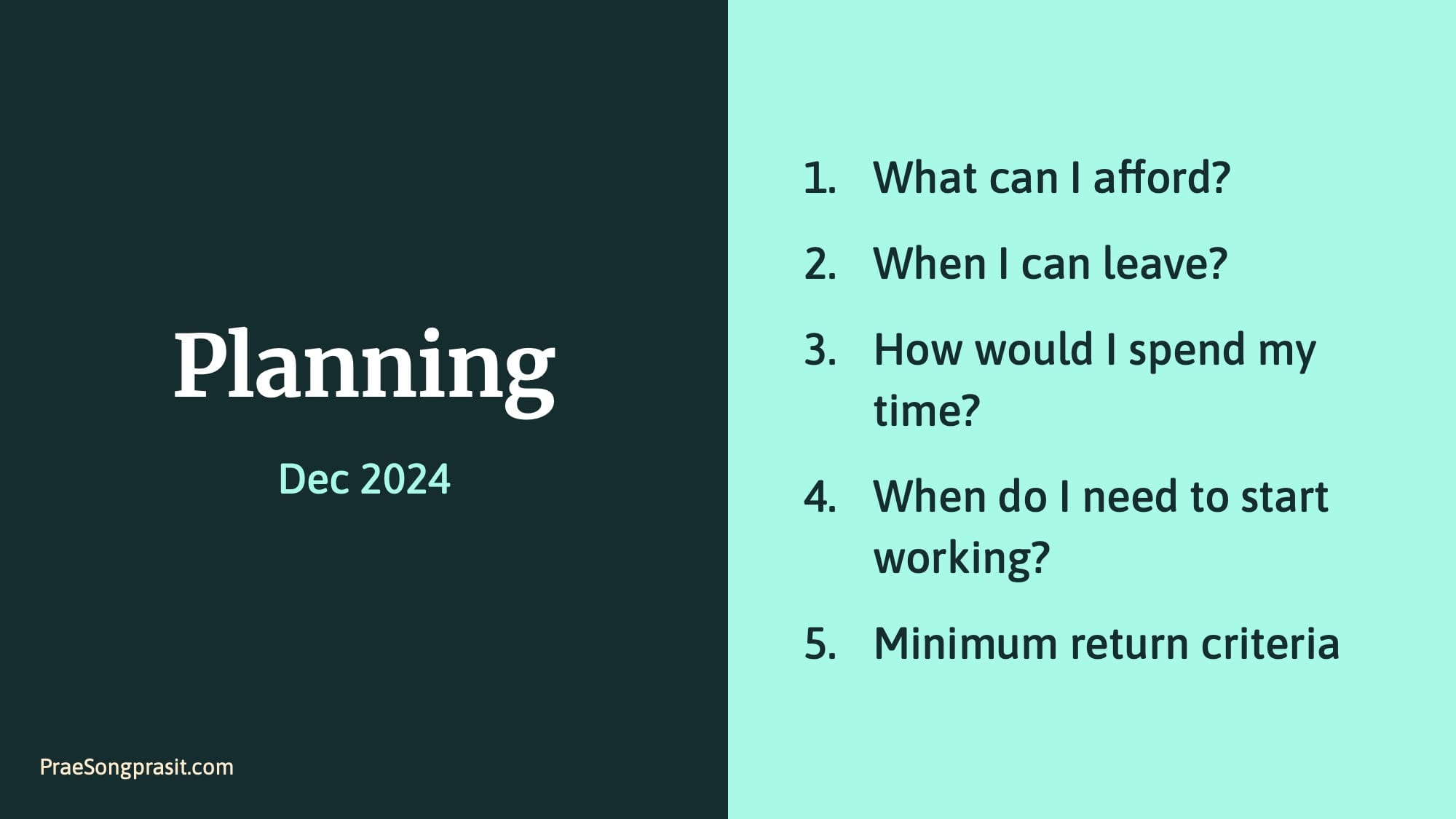
So — how do you actually leave? In December I was planning, because in October I was completely burnt out and just dealing with processing the causes. By December I arrived at the thinking point, and of course it's end of year, everyone thinks about resolutions and plans.
In order to leave, I needed to work out what I could actually afford. How much money do I have in my bank account? How much am I spending a month? I've been quite lucky — I've been good with money most of my life. I roughly know that from my monthly income, I save this much just for expenses, and the rest I stash in an investment account. I have a very consistent stream of expenses. So I multiplied that by however many months and got my financial runway — how long can I go without income until I needed a job again?
I worked out somewhere between 8 to 12 months, which is damn lucky. It also means: I hadn't travelled since COVID, so that's probably why I had all those savings, and I'd been saving for a house which I no longer plan to buy.
Working out that runway was step one. Working back from there: when does my saving actually start depleting? When can I actually leave? I discovered that some companies — if you're in a startup or scale-up with share vesting — you want to make sure you collect those shares before you actually resign. So this is where you go and read your employment contract, understand the remuneration rules. If your employer provides health insurance, how much would that cost if you were paying it yourself? Do you need to cancel it, adjust it? These are things we hardly think about, but they factor into your runway, and that's how I worked out when to leave.
I also needed to plan how I'd spend my time, because taking a break to go travel the world is different from taking an intentional career break to recover and prepare yourself for the next phase of your career. You don't want to be wasting time — and rest is not wasting time, but resting for eight months doing nothing is wasting time. So let's be intentional.
Because I had events I'd promised to help with, I roughly pinpointed my schedule loosely. I left my timeline open enough that if I didn't hit things exactly, there were only about three deadlines in the next 12 months — that's fine. Then I worked out when I needed to start looking for work, because I already knew my runway and my rough timeline. A specialist role takes about three months to find. So if my runway is eight months, I should start casually networking and browsing about five months in, to give myself time.
So I left in April — I resigned in March. What did I do for eight months?
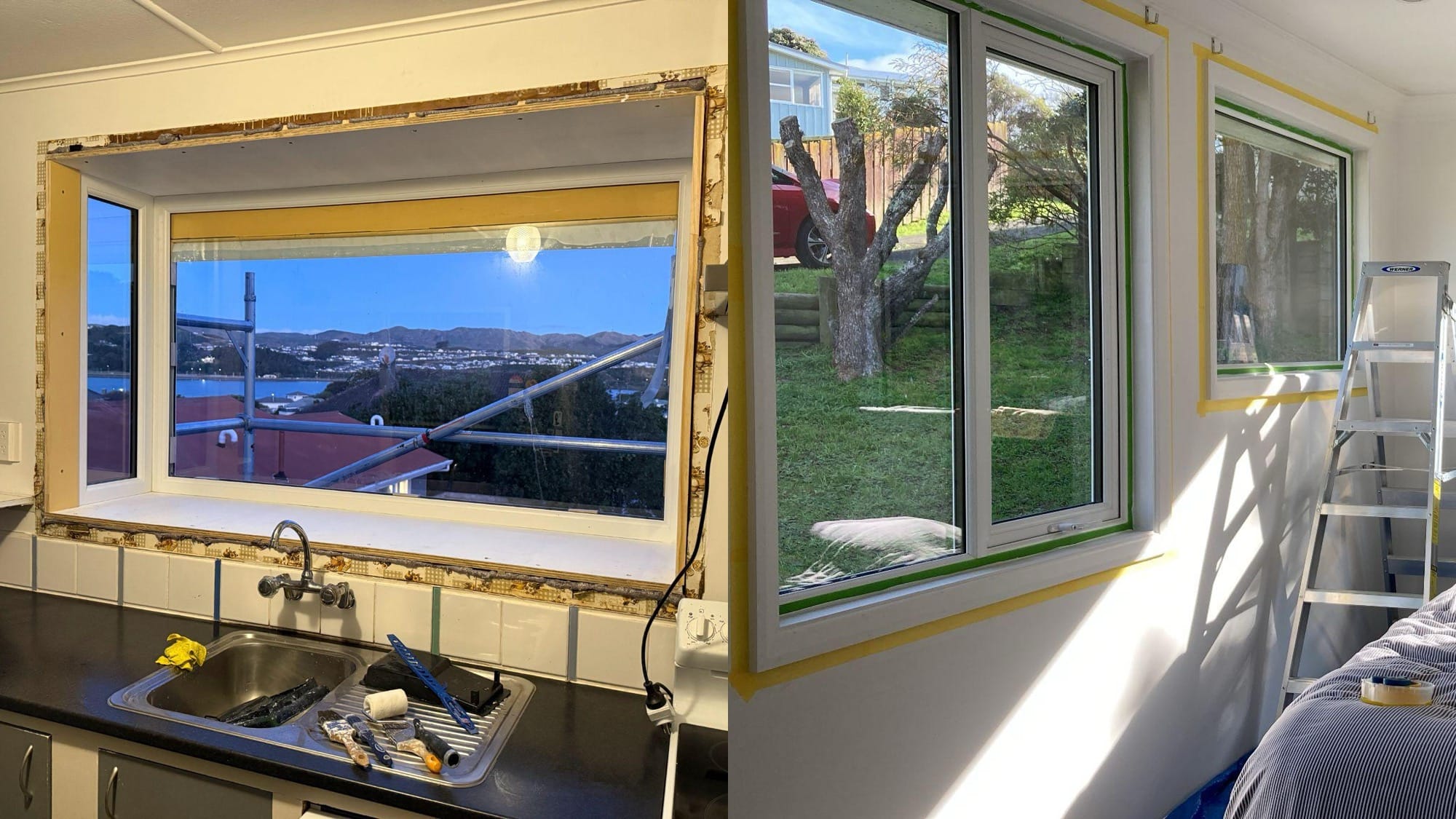
Turns out I swapped a 9-to-5 office job for an 8-to-9 full-time construction role.
My house is a classic single-glaze aluminium-frame, not thermally broken home, and we'd been saving for double glazing for a few years. The glaziers called with availability four months ahead of schedule — so I was like, well, okay, I suppose I'll go and do that. The thing with double glazing is that once they install the windows and frames, you need to paint and seal around them to meet the waterproofing warranty. So I was doing DIY — a whole month of eight to nine hours a day. My back was not enjoying it, but the end result was great. We now have a nice warm home for the summer (NZ did not have a real summer between Dec 2025 to Feb 2026).
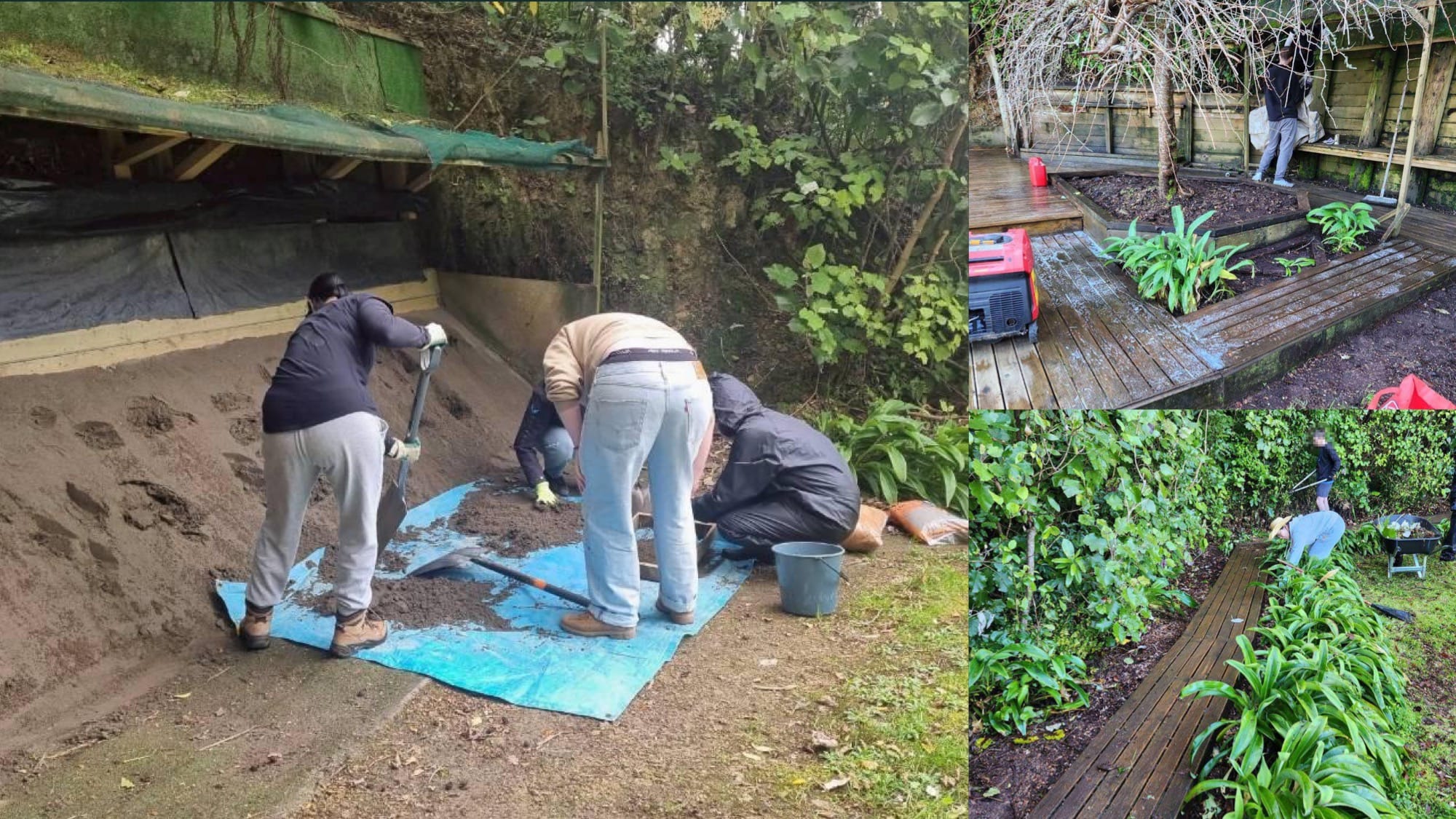
I also did DIY at the Kyudo dojo. We have a 10-year-old outdoor dojo that is beautiful — you hear birds singing — but it had zero cover, unsealed slippery decking, and nothing had been done to it for 10 years. So for health and safety reasons, we had to scrub the whole thing clean and try to seal it. That was two and a half months of my 8-to-12 month runway, gone.
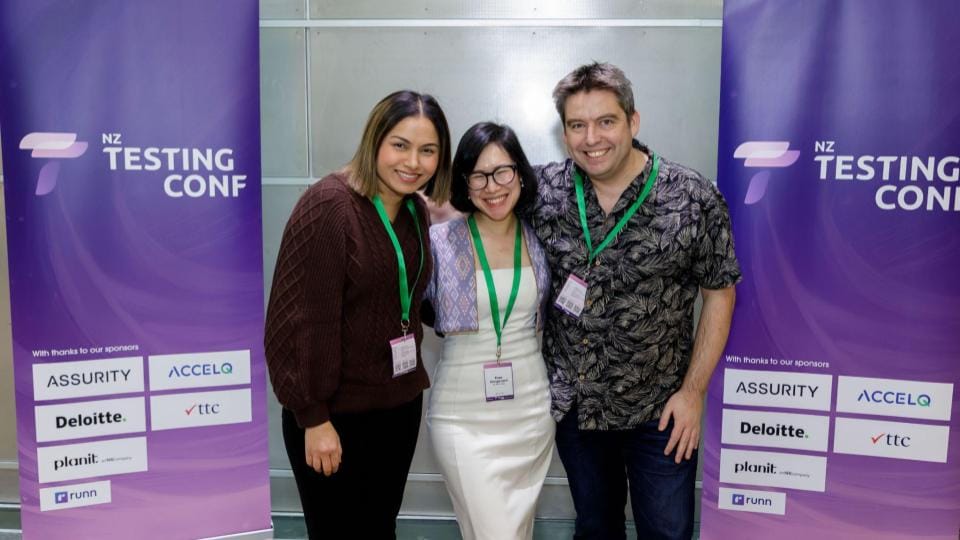
I mentioned before that I co-founded NZ Tech Rally but left. I took that opportunity to make sure the paperwork was properly sorted — the director properly leaving the company register, everything signed, everything split.
It was sad losing ownership of that community, but I was invited to join others.
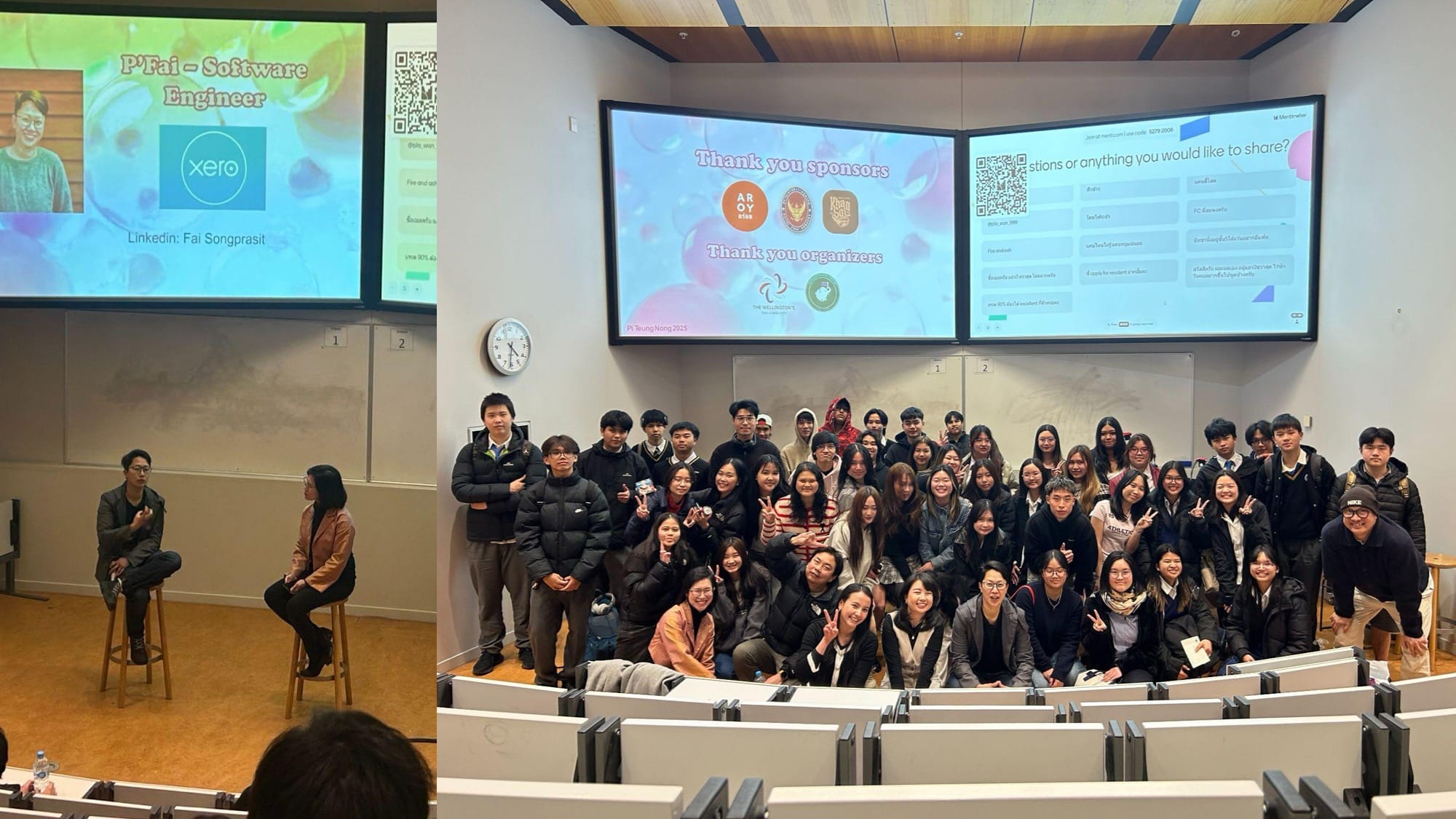
I ended up MCing an experience-sharing event for the Thai community, where Thai students had studied in New Zealand but had no idea what to do in the local job market afterwards — just us sharing stories. That was cool.
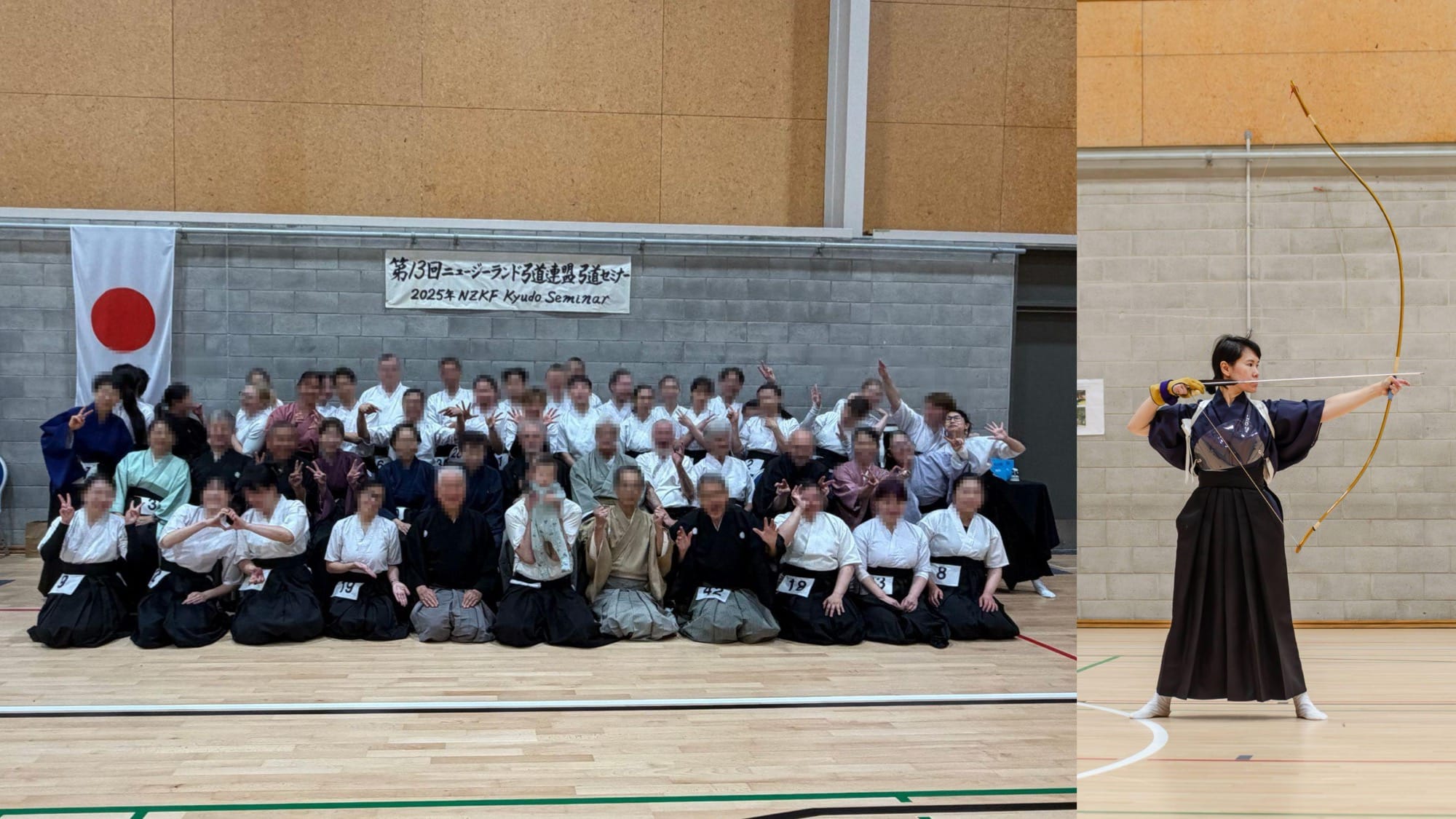
I also went hard on Kyudo. Not only was I doing the DIY for the dojo, but I was also involved in organising our 10th anniversary event for Wellington Kyudo Club. We had Japanese teachers fly over, all sorts of logistics.

Then right after, I escorted my very senior teacher back to Japan, and while I was there, I took the opportunity to sit my third-grade examination. Then I travelled Japan for a bit, my husband joined me, and we did a theme parks tour. Some DIY work, some fun, some rest — refilling my cup a little bit.
By October–November, I was at the three-month mark. I'd worked out in the end that I actually had 12 months rather than eight months, so I was casually starting to look and reconnect with my network.
As I was looking, I set myself conditions based on what I'd learnt about myself.
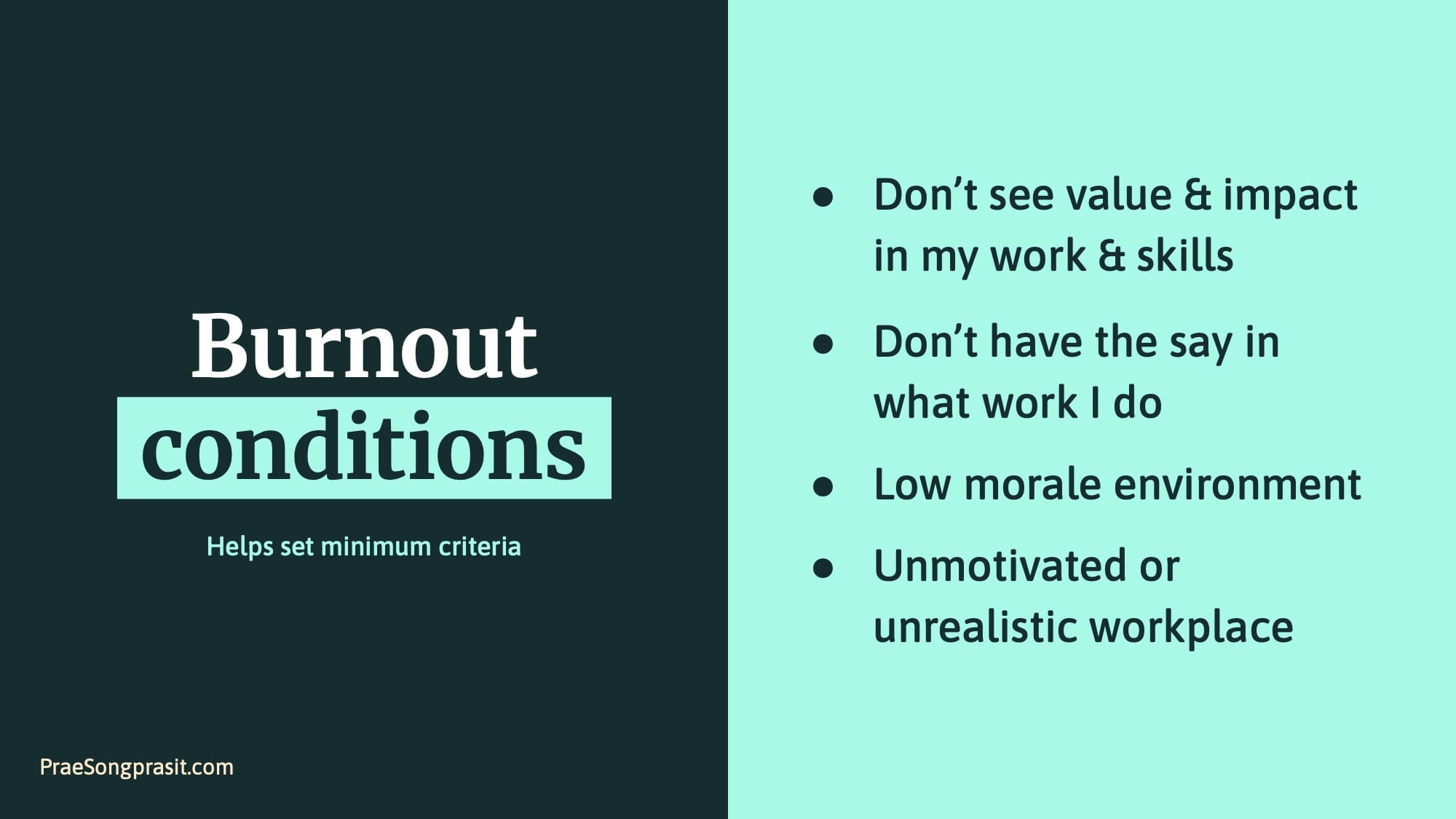
I know I get burnt out when I don't see value in my work, when I don't have a say in what I do, when I'm in a low-morale environment. So the new place can't be somewhere that's going downhill, being sold, or in chaos. I can't work with an unmotivated or unrealistic workplace. Those things just burn me out immediately.
So what does that translate to in positive terms?
For a post-burnout role:
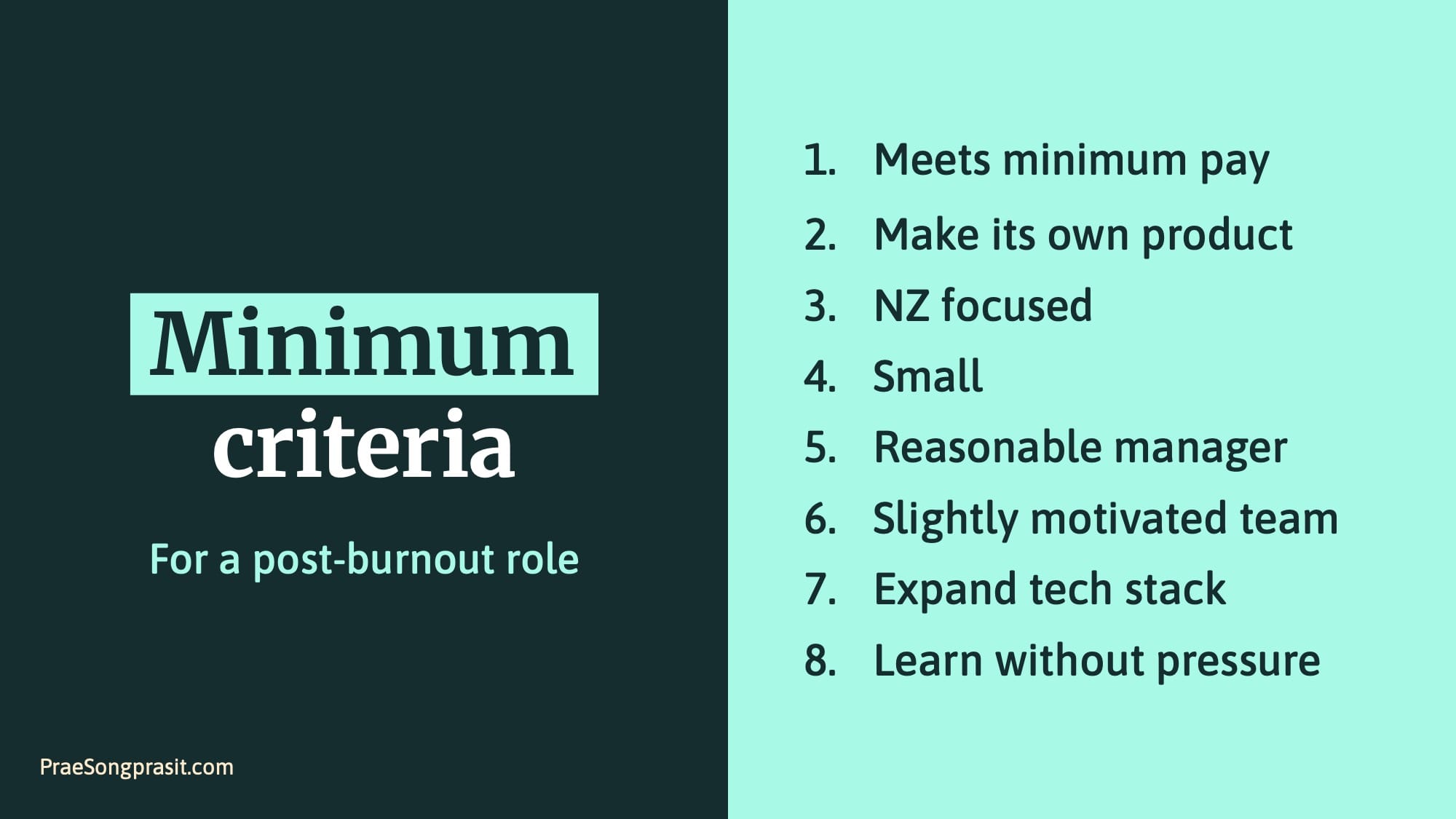
Minimum salary: enough to cover my expenses and save a little bit. Job market's tough — I can't be too choosy — but there's a floor.
Own product company: I want to avoid digital agency work where I'm only allowed to care for 40 hours and then leave half-finished work behind.
New Zealand focused: not because I'm patriotic, but I want to be in a company stable enough to be comfortable serving the NZ market — not in a mad rush to scale up elsewhere. I want stability.
Small company: because my tendency to help with collaboration and communication would expand to encompass 20 people rather than 28,000. If I expand my scope at a small company, it expands to a manageable size.
A reasonable manager: I was talking to Katrina earlier, and my condition was specifically a manager who will manage me for longer than six months. At my previous company, I had 10 managers over seven years. In the last year alone, I had six. That's enough.
I also want a slightly motivated team — and the key word is slightly. I don't want hyper-ambitious. I want people who care enough about what they do that if there's an improvement that should be made, they'll go ahead and do it — but not so much that we're going to take over the Australian and US markets this quarter.
I also want to expand my skill set and tech stack. The things I've been afraid of in the backend, or getting away with not doing — let's make sure I actually go learn those things.
And I want to learn without pressure. So if I take a lead or manager role, I need someone more senior or more accountable above me, so that the pressure of making mistakes is taken off me while I'm learning.
I ended up with offers from two companies.
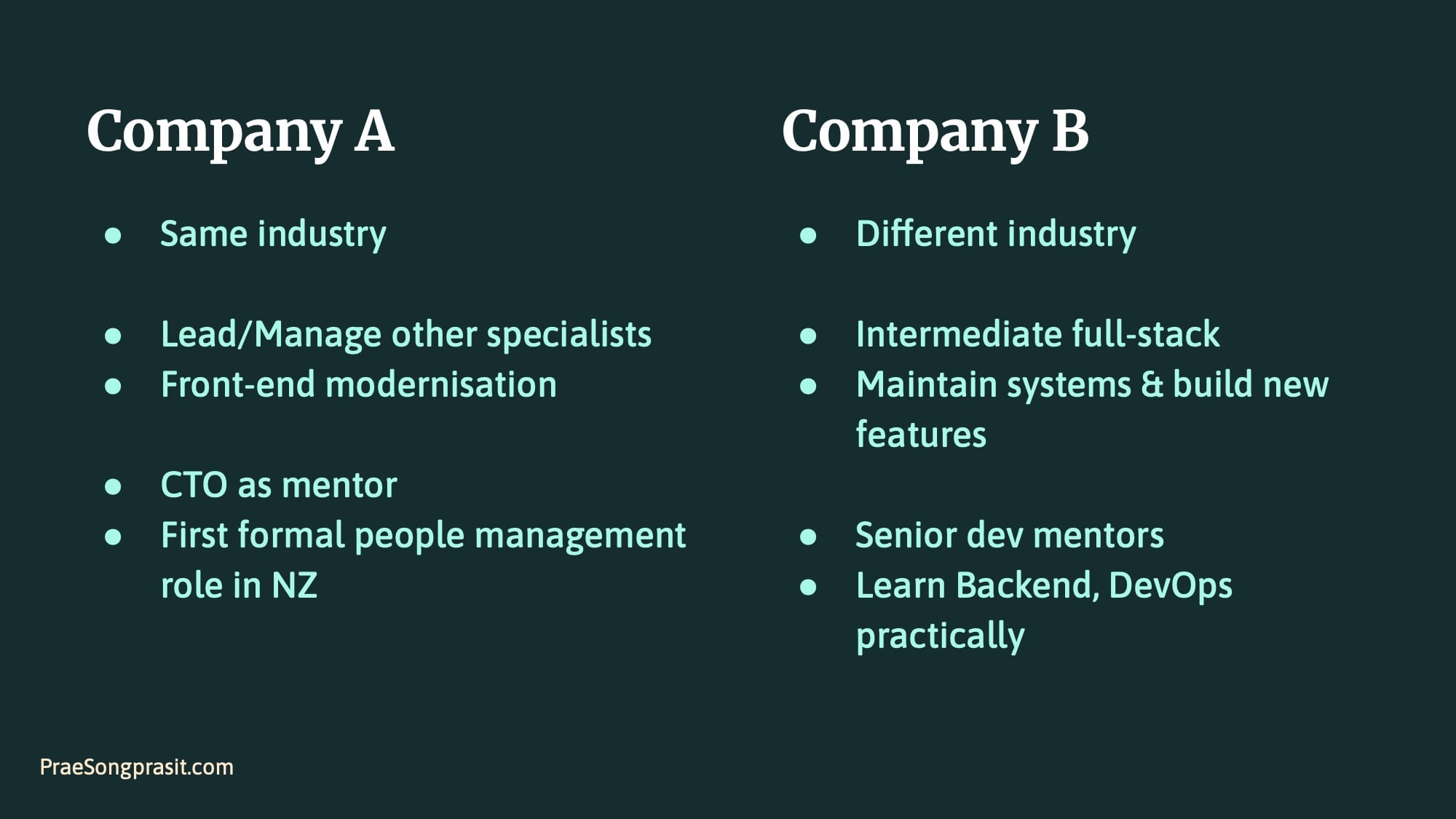
Company A: same industry as my previous workplace, lead type role managing other specialists, front-end modernisation work — right up my alley. The CTO himself would be my mentor. That would also be my first formal people management role in New Zealand.
Company B: completely different industry, intermediate full-stack role — a step back in title, but senior devs who could mentor me through the system, and I'd get to learn backend and DevOps in a practical way.
Based on how I understood myself and the conditions I'd set, I realised Company B was the better fit for my needs right now — or at least for the next few years.
When people ask me how I'm enjoying it, I'm like:
"How can I enjoy somewhere that doesn't care about design or front-end?"
But am I learning?
Am I meeting the goals I set out for myself — to recover from burnout, to be in a place where people are slightly motivated?
Yes. There's enough here.
Am I doing the things I wanted to do when I set out?
Yes.
So I'm satisfied, and I'm slowly feeling joy again — not quite in work, but in my hobbies. I've brought them back over the last eight months, and some of them have really stuck.
Now I'm in monitoring mode. Making sure I don't slip into yet another burnout. The flags for myself are multi-staged.
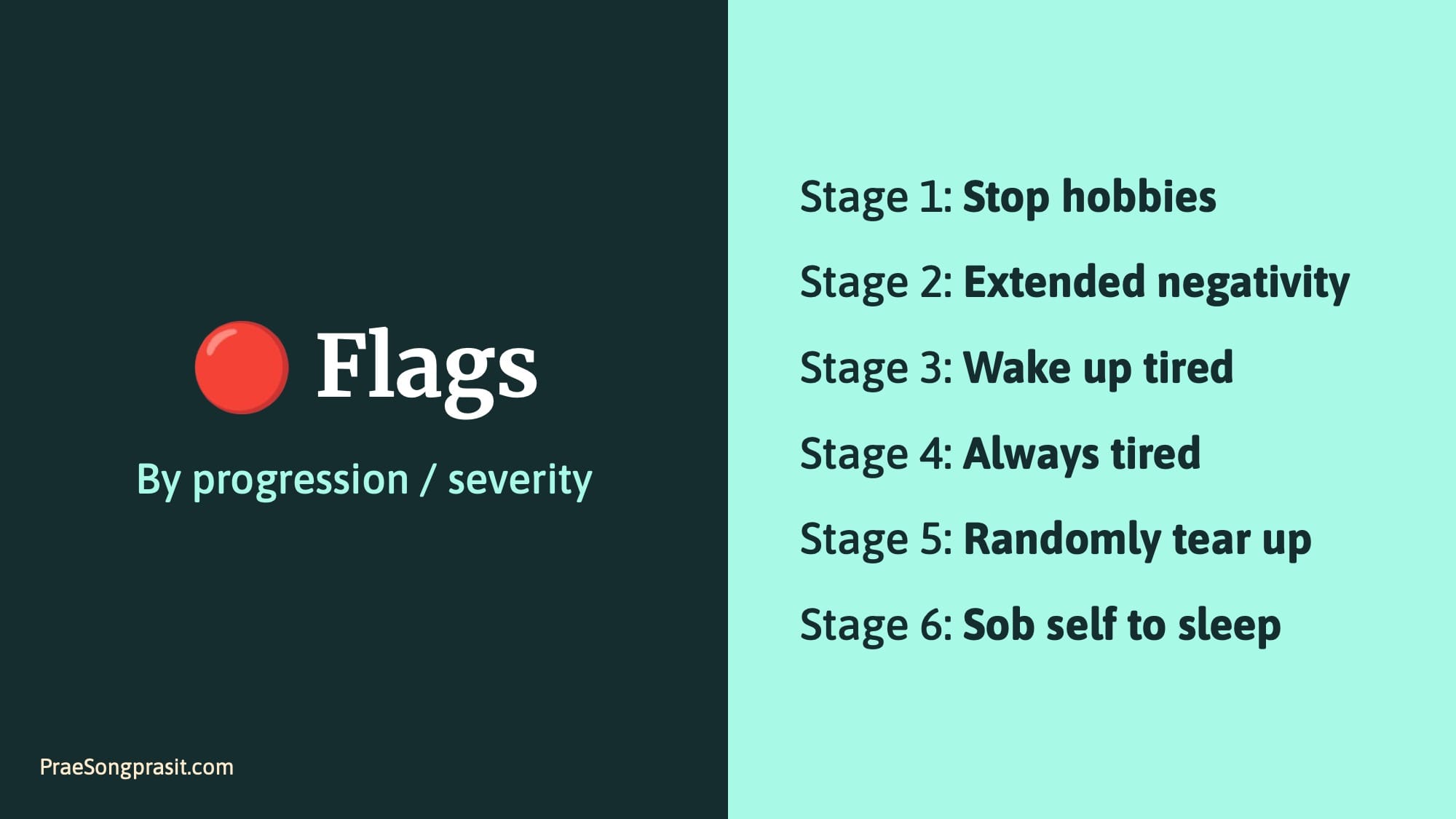
Stage one: I stop doing hobbies. I'm not going to stop doing Kyudo anymore — I made that mistake in my first burnout. But I've stopped other hobbies, stopped switching around them, stopped tinkering. That's stage one.
Stage two: I've become more negative — not just on a particular project, but generally, when I interact with people. Not neutral, but negative. That's the next warning sign.
Stage three: waking up tired. Sleep is lovely. I love staying in bed, lounging, eating junk. But if I wake up tired regardless of what I did to recover — that's a warning sign.
Stage four: if I'm always tired, that's another flag.
Stage five, the more extreme stage, when it gets bad enough that I need to see a counsellor: I start randomly tearing up when I think about certain themes or topics.
Stage six is when I need to get out. Stop working. Like I did in burnouts two and three — crying myself to sleep at night.
Not everyone can afford to stop for eight months and then take a minimum salary like I did. I don't have kids. I do have some mortgage, but nothing like a lot of you have. So some of you can't afford this — but the takeaway is this:
Learn what motivates you. Learn what fulfils you. Set personal goals — not crappy business OKRs where you have to achieve tasks by end of quarter, but more like: why are you working in this role, in this organisation?
Once you've learnt what keeps you grounded, adapt how you service those needs based on what you're feeling. Know your red flags. Know your personal goals. And when you know that, that is a path to a more sustainable career — so that you don't have to take a gigantic career break again.
Hopefully none of you experience something as bad as this. Please learn from my mistakes.
But yes — it always pays to know thyself. Thank you.